7 historic landmarks around Marbella worth knowing
From Roman roads and early Christian ruins to Moorish walls and coastal watchtowers, these landmarks reveal the older stories behind Marbella’s modern identity.
Historic landmarks around Marbella
Marbella is often understood through its lifestyle: beach clubs, five-star hotels, restaurants, tennis, golf and luxury homes. Yet beneath that polished image is a much older place, shaped by Roman routes, Islamic fortifications, Christian town planning and centuries of coastal defence.
From Puente Romano’s own historic bridge to the walls of Marbella Old Town and the watchtowers of the coast, these landmarks offer a different way to experience the area. They reveal how Marbella’s architecture has been built over time, layer by layer, and how its history still forms part of everyday life here.
1. Puente Romano Bridge, Golden Mile

The most fitting place to begin is with the landmark that gives Puente Romano “Roman Bridge” its name.
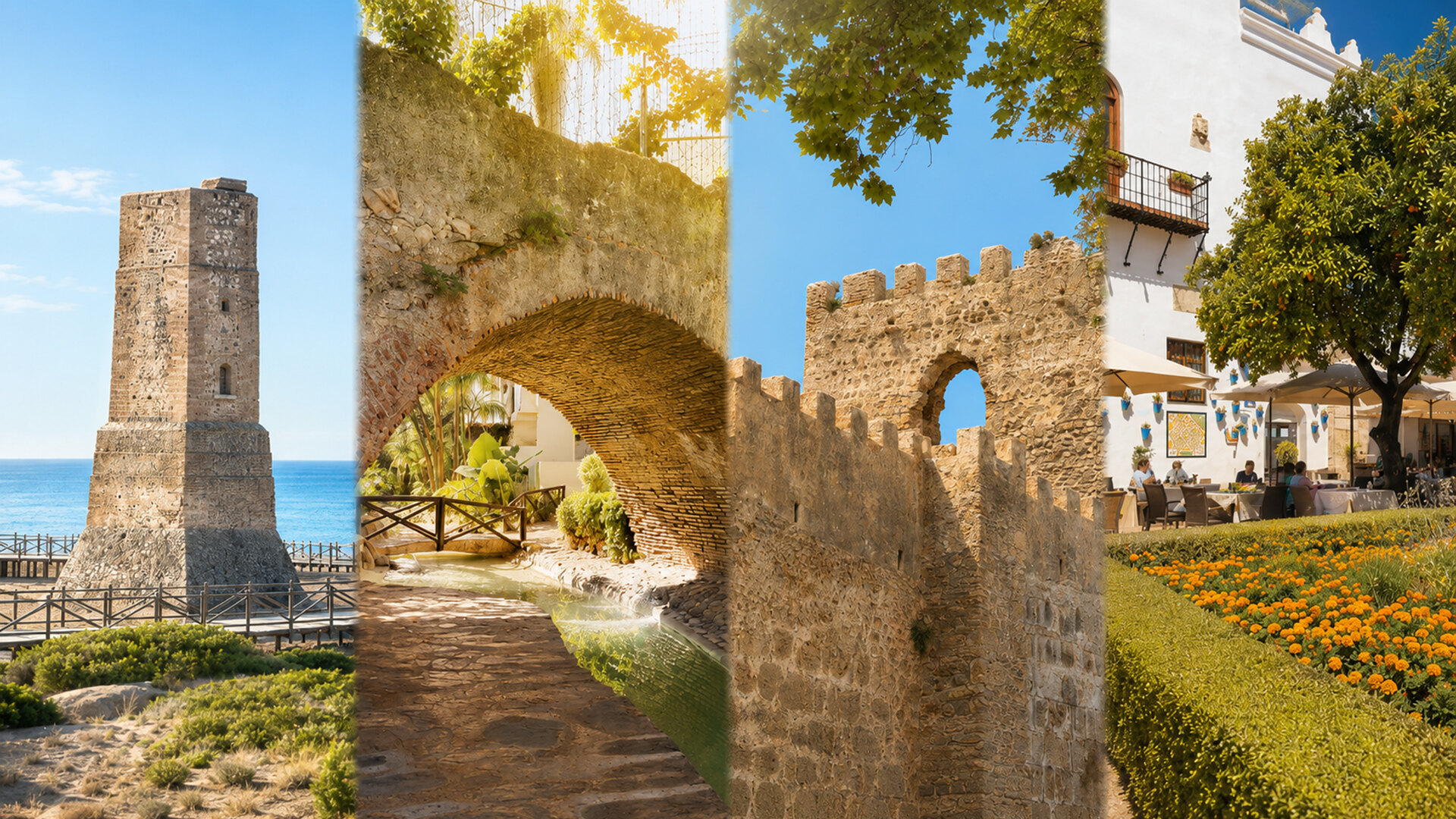
Set within the subtropical gardens of the Puente Romano Beach Resort, this ancient bridge is relatively small in scale, but deeply significant to the identity of the resort. Dating to the 1st century AD, it formed part of the ancient Vía Augusta, the Roman road that once connected settlements along southern Hispania, linking the Cádiz coast with wider routes towards Rome.
Long before Puente Romano became one of Marbella’s most renowned resort destinations, this stretch of the Golden Mile was already part of a historic coastal route. Today, the bridge still stands beautifully at the centre of the resort, surrounded by mature gardens, pathways and Mediterranean planting.
Over 2,000 years ago, this roman bridge would have provided an important crossing over a small stream, allowing goods, soldiers and travellers to continue along this vital coastal trade route… and today, you can still visit it and take a selfie!
Address: Puente Romano Beach Resort, Bulevar Príncipe Alfonso von Hohenlohe, s/n, 29602 Marbella, Málaga, Spain
GPS coordinates: 36º 30’ 14.50” N, 4º 55’ 29.50” W.
2. Roman Villa of Río Verde

Just 1km west of Puente Romano, near the Río Verde, the Roman Villa of Río Verde is one of Marbella’s most important archaeological sites. Dating back to the late 1st century AD, it preserves the remains of a Roman villa, best known for its decorative mosaic floors and its location within what was once a Roman settlement around 5km from Marbella.
The villa offers a rare glimpse into Roman domestic life on the coast. Rather than grand imperial architecture, its interest lies in the details: the flooring, the layout, fragments of walls and the sense of a prosperous Mediterranean residence connected to agriculture, trade and the sea.
Address: C. Carlos Posac Mon, 1D, 29600 Marbella, Málaga.
Google Maps: Villa Romana de Río Verde.
3. Roman Thermae of Las Bóvedas, Guadalmina

Further west, near Guadalmina and San Pedro de Alcántara, Las Bóvedas, also known as Termas Romanas de Las Bóvedas, is another key Roman site. Built as a two-storey complex arranged around a central octagonal space, its remains are one of the most distinctive ancient structures in the Marbella area.
The site is often interpreted as Roman baths, although its precise historic function has been discussed by archaeologists over time.
Address: A-7, km 170, Urbanización Guadalmina Baja, Marbella / San Pedro de Alcántara, Marbella, Málaga, Spain
Google Maps: Las Bóvedas Roman Thermae.
4. Vega del Mar Paleochristian Basilica, San Pedro de Alcántara

Close to Las Bóvedas, the Vega del Mar Paleochristian Basilica reveals another important layer of Marbella’s past: early Christianity on the Costa del Sol. Located near the mouth of the Guadalmina River in San Pedro de Alcántara, the site preserves the remains of a basilica and an extensive necropolis, with around 200 tombs discovered in the surrounding area.Its double-apse layout is one of its most distinctive architectural features, while the presence of baptismal basins points to its role as a place of worship and community.
Surrounded by eucalyptus trees, the basilica feels almost hidden, more like a discovery than a formal attraction. Only the foundations and low remains survive, but that is exactly what gives the site its atmosphere: a sacred coastal place that reminds us how far back Marbella’s story truly reaches.
Address: Urb. Linda Vista Playa, C/ Eucaliptos, 29670, 29670 San Pedro Alcántara, Marbella, Málaga, Spain
Google Maps: Basílica Paleocristiana de Vega del Mar
5. Marbella Castle Walls and Alcazaba

In Marbella’s Old Town, the remains of the castle walls and Alcazaba reveal the city’s Islamic past. Dating mainly from the 11th and 12th centuries, the walls once formed part of a fortified defensive enclosure punctuated by towers. Today, sections can be seen around the historic centre, particularly near Calle Carmen, Calle Salinas, Plaza de la Iglesia and the streets surrounding the old castle perimeter.
These walls are among the most important historic remains in central Marbella, and they change the way you experience the Old Town. What may first appear as a picturesque Andalusian maze of whitewashed streets is, in fact, the footprint of a fortified medieval settlement. As you walk between the church, small squares, restaurants and boutique-lined lanes, the stonework offers a reminder that Marbella’s historic centre was once a protected walled town.
Address: 29601 Marbella, Málaga, Spain
Google Maps: Castillo de Marbella
6. Plaza de los Naranjos, Marbella Old Town

Plaza de los Naranjos is one of Marbella’s most recognisable historic spaces and the natural centre point of the Old Town. Created after the Christian conquest of the city in 1485, it became the civic and administrative heart of Marbella, replacing the enclosed structure of the former Islamic medina with a more formal Castilian-style public square. Today, it remains framed by some of the town’s most important historic buildings, including the Town Hall, Casa del Corregidor and Ermita de Santiago, believed to be the oldest religious building in Marbella.
Its atmosphere is part of its appeal. Orange trees give the square its name, while café terraces, tiled façades, balconies and shaded corners make it one of the most photographed places in the historic centre. It is also one of the best starting points for exploring the surrounding lanes, with the Church of Nuestra Señora de la Encarnación, the castle walls, boutique shops and traditional restaurants all within a few minutes’ walk.
Address: 29601 Marbella, Málaga, Spain
Google Maps: Plaza de los Naranjos
7. Torre Ladrones, Cabopino

To the east of Marbella, beside the Artola dunes and Cabopino beach, Torre Ladrones, or “Thieves Tower”, is considered the tallest watchtower on the Málaga coastline, standing 14.60 metres high, giving it a wide field of vision over the Mediterranean. Its square structure measures 3.65 metres on each side and is arranged over three internal floors, with a rooftop terrace that once served as a lookout point.
The tower’s name is linked to the defensive ladroneras, or overhanging machicolations, used to protect the structure from attack. Surrounded today by wooden walkways, sea grasses, coastal pines and open views towards the sea, Torre Ladrones proves Marbella’s coastline was carefully watched, guarded and strategically connected.
Address: Diseminado Poligono 15, 1, 29604 Marbella, Málaga, Spain
Google Maps: Torre Ladrones
Be part of Marbella’s story with Puente Romano Real Estate
Live close to the places that give Marbella its character, and become part of the story. From Puente Romano and the Golden Mile to Marbella Old Town and the wider coastline, our team can help you find a home that brings together lifestyle, location and lasting value.
Call (+34) 952 768 204, or if you are staying at Puente Romano or Nobu Hotel, dial 28004 from your room.